

Low Fee Private Schools: Last Hope or Lost Hope?
 I got a chance to help in organizing the recently held USAID sponsored low fee private school conference held at LUMS. The fact that international donors such as USAID and DFID are interested in funding projects in this area is reflection of the exponential growth in the low fee private sector in Pakistan in recent years. However, the million dollar question, as mentioned by Irfan Muzaffar in his article, “Education on Sale”, is whether the growth of this sector is a sign of strength or a symptom of a disease: the state failure in provision of education.
The very reason behind the emergence of the low fee private school sector is the persistent failure of the public school system in providing access to reasonable quality education for all. There are strong advocates both in favor of and against the unfettered growth of the low fee private schools and both sides make strong cases for their respective stances. Proponents of the private school system, like Justin Sandefur in his blogs for the World Bank, make the case for private schools by citing that the push for universal primary education through the public school system has been largely unsuccessful, using Kenya and Pakistan as case studies. Many scholars believe that the private sector should, therefore, play a prominent role in providing access to education –as Harry Patrinos puts it in his blog, “a good public education system means public spending, but not necessarily public provision”. Therefore, the role of private sector in increasing access to education is one that should be further explored.
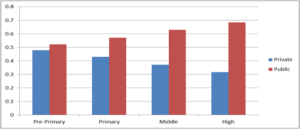
Contextualizing the private versus public debate for the case of Pakistan, figure 1 shows that the private sector’s share of enrolment is largest up till the primary level. This is particularly interesting since the right to universal primary education granted through Article 25-A of the constitution of Pakistan made public schooling free for all. Yet, the proportion of public sector enrolment up till the primary level is lowest of all the school levels.
Figure 1: Proportion of students in Private and Public schools by School Level
Source: Pakistan Education Statistics 2011-12
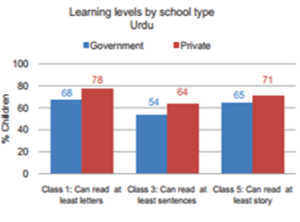
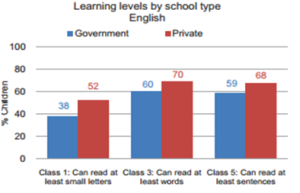
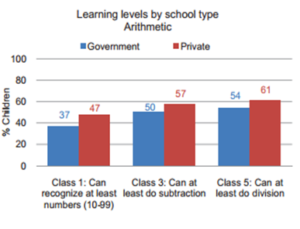
In order to develop a better understanding of the quality dimension in the private vs public debate, let’s look beyond enrolment and focus on learning outcomes in Mathematics, English and Urdu. Whereas the private schools seem to be doing better than public schools according to reports such as ASER (see figures 2, 3 & 4 below), the nature of the problem is far more complex. So, even though private schools seem to be doing better, overall learning levels remain below par by international standards.
Figure 2
Source: ASER Report 2013
Figure 3
Source: ASER Report 2013
Figure 4
Source: ASER Report 2013
The advocates of a greater role for private schools, such as Justin Sandefur in his blog, make their case for private schools by citing high performance gaps between public and private schools (in countries such as Kenya) that cannot be overcome by well-documented, successful interventions in the public schools. Moreover, he argues against the affordability issue by refuting the idea that private schools are too expensive to afford for poor families and cites increasing enrolment numbers in private schools as evidence of parent’s willingness to pay for their children’s education. He addresses the equity issue by advocating for the introduction of voucher programs to ensure that all parents, regardless of their income, can choose the school for their children that best matches their preferences.
On the other side, the opponents of unregulated growth of private schools, such as Kevin Watkins, in his blogs, admit that there is no denying the need to fix the quality of public education but argue that the solution is not to circumvent the public school system by simply promoting the private sector at the expense of the public sector. He argues that the very well documented performance gaps between private and public schools may not hold once we control for the differences in the quality of infrastructure and student intake between the schools (self-selection of the more able kids into private schools). Moreover, in order to reemphasize his point, he argues that even in cases where there are significant learning gaps between private and public schools, these gaps tend to weaken as more students are absorbed into the private schools from the poorer segments of society.
Kevin Watkins, being an advocate of pro-public reform in his blogs, also raises serious concerns about the notion of equity (due to affordability concerns) as the private sector “offers choice for some as opposed to opportunity for all”. He points towards existing research which shows that low-fee private schools are unaffordable to the lowest quintiles and argues that even lower middle class parents would prefer to send their children to public schools that offer quality education. The bigger question then, as put by Watkins, is: “why should we tolerate a state failure that leaves some of the world’s poorest households facing prohibitive user-fees to secure their children’s right to education?”
Therefore, in addition to the affordability issue related to private schools, there are also issues with the notion of a simple scale-up of the private sector as a solution to solving the quality concerns in the education sector. As overall learning levels remain poor in both public and private schools in Pakistan, the need is a greater role for the state in fixing the education system in order to ensure better access to quality education while catering to equity issues. This greater role of the state should be both, in the form of improving the public system, as well as in the form of regulation of the low fee private sector as a means of facilitating access to affordable and quality education for all.
Disclaimer: The views expressed here are those of the authors and do not necessarily represent the views of the Institute of Development and Economic Alternatives