

Learning Beyond the Classroom: Private Tuition – GOOD OR EVIL?
Today, children enter the education system at the age of just two and a half; by 16, many are undertaking more than ten ‘A’ levels when the minimum requirement is only three. It is not surprising therefore, that teaching time has also spread outside the eight-hour school day and expanded in the form of after-school private tuition. Often termed “shadow education”, private tuition has firmly established itself alongside the public and private education sectors and is widely acknowledged as the third major sector of education in Pakistan. Although the concept of “tuitions” has existed for some time, its spread and connotation has changed over the years. Previously, tuition classes were taken mainly by students preparing for board exams, with a handful of reputable instructors who were sought after for such classes. Now private tuition is no longer limited to secondary or higher secondary students, nor is it bound to the urban world. According to the Annual Status of Education Report (ASER), approximately 25% of primary school students and 26% of students living in rural areas receive paid after-school tuition in Pakistan. These classes range from one-to-one tutoring sessions held at students’ homes to larger classes held at tutoring academies. This high prevalence of private tuition and its nexus with mainstream schooling raises the question, why do students engage in private tuition? More importantly, how do these classes affect academic performance and the dynamics of the education sector in general?
Who engages in private tuition? It is often believed that such classes serve as a form of remedial education for low-performing students or supplement poor-quality mainstream public schooling. However, evidence from the Learning Educational and Achievement in Punjab Schools (LEAPS) survey and ASER data suggests the opposite – around 34% of private school students in the Punjab receive private tuition compared to only 11% of public school students (ASER, 2012). Moreover, analysis of the LEAPS data suggests that parents’ perception of their child’s intelligence is directly related to tuition uptake, i.e. the more intelligent the child is perceived to be by his or her parents, the more likely he or she is to receive tuition. This is not surprising: with the increasingly competitive nature of education and parents’ desire to help their children secure the greatest possible marks in their examinations, private tuition is thought to bolster the performance of students who are already doing well. If this is so then the next question that needs to be addressed is whether private tuition actually affects academic performance. Does it enhance student performance or simply over-burden the child, with negative consequences in terms of learning?
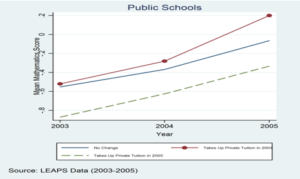
Although ambiguous evidence exists on the impact of private tuition on learning, a number of studies on Pakistan and other countries suggest that private tuition often leads to gains in academic performance (see, for instance, Dang, 2007; Kang, 2007; Aslam & Atherton, 2013)[1]. Using the LEAPS data, Figure 1 below presents some evidence on the positive impact of private tuition on learning outcomes for public school students. The slope of the red line indicates a positive gain in academic performance for students who received private tuition in 2004. Although test scores seem to rise over time even for students who did not receive private tuition in any period, those who received private tuition in 2004 see a steeper rise in their test scores, especially in 2005, suggesting positive gains from tuition, which are realized with time.
Figure 1: Academic Achievement over Time for Private Tutees and Non-Tutees
However, these findings should be taken with a pinch of salt. A number of caveats need to be addressed before private tuition is declared a panacea for all the ills that plague Pakistan’s education system. First, academic performance as measured by test scores merely measures the ability of a student to take a test and not his or her actual capacity to learn. It could be that private tuition encourages rote learning and teaching-to-the test. If this is the case, then despite the positive effects on test scores, private tuition may prove detrimental to student learning and intellectual development. Further, private tuition, like private schooling, raises equity concerns – do students from different socioeconomic backgrounds have similar access to private tuition? If not, then private tuition exacerbates the education gap between the rich and the poor by creating opportunities for the rich that remain out of reach for the lower classes. Last, the heterogeneity of the private tuition available has implications for its quality and utility. It could be that only a certain form of private tuition has beneficial effects on academic performance, which, if averaged out over all types of private tuition, mask the detrimental impact of other forms. This needs to be kept in mind before inferences are made, especially since data on the different kinds of private tuition are not available.
The rapid embedment of private tuition in Pakistan’s education system makes it crucial that we address these concerns and develop an understanding of the dynamics of the private tuition market. As a start, documenting the different forms of private tuition, their respective prevalence and their impact on academic performance, is essential. Further, from a policy perspective, it is important that we understand the fundamental aim of an education system – is it a results-based approach where the only concern is students’ test scores achieves or is it something more? Once this is clear, it will become apparent whether private tuition contributes to this aim or detracts from it. This indeed is a first-order question that needs to be addressed before the debate on private tuition can be of any consequence for policymakers.
[1] H. Dang, ‘The determinants and impact of private tutoring classes in Vietnam’, Economics of Education Review, Vol. 26, issue 6, 2007, pp. 683-698; C. Kang, Does money matter? The effect of private educational expenditures on academic performance, National University of Singapore, Department of Economics Working Paper No. 0704, 2007; Monazza Aslam & Paul Atherton, The shadow education sector in India and Pakistan: the determinants, benefits and equity effects of private tutoring, mimeo, Institute of Education, University of London, UK, 2013.
Disclaimer: The views expressed here are those of the authors and do not necessarily represent the views of the Institute of Development and Economic Alternatives